 Kumasipioneer.com Truth l Accuracy l Fairness
The Asantehene, Otumfuo Osei Tutu II, has reaffirmed that allodial ownership of all lands within Asanteman is vested exclusively in stools, which hold such lands in trust for the Golden Stool.
He said families and individuals in Asante cannot lay claim to allodial title, and can only hold leasehold or usufructuary interests granted under customary law.

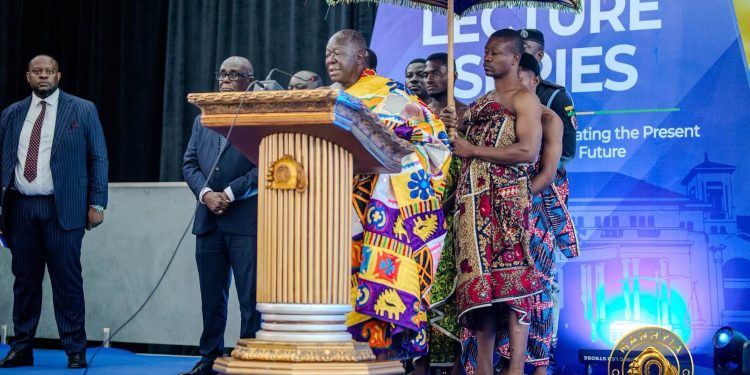
The Asantehene made the pronouncement on Wednesday during a public lecture at the Manhyia Palace in Kumasi. The lecture formed part of activities marking the 150th anniversary of the Supreme Court of Ghana.
“All Lands Vest in Stools for the Golden Stool”
Addressing legal practitioners, chiefs, and academics, Otumfuo Osei Tutu II said the matter of land ownership in Asante continues to generate agitation, uncertainty, and litigation.
He stressed that the customary structure of Asanteman leaves no room for competing allodial claims by families.
“First and foremost, it is imperative to state for emphasis that in Asanteman, allodial ownership of land vests in the stools, who hold the same in trust for the Golden Stool.
There are no family allodial lands in Asante; therefore, families and individuals can only hold leasehold or usufructuary interest in lands in Asante, but never allodial interest in or title,” he stated.

The Asantehene explained that while families and individuals may use and occupy land, their rights are derivative and subject to the overarching authority of the stool.
KNUST Lands Cited as Example
To illustrate his point, Otumfuo cited ongoing disputes involving portions of land belonging to the Kwame Nkrumah University of Science and Technology, KNUST.
He recounted that the university lands were originally demarcated by his predecessor, who was a trained surveyor before ascending the Golden Stool, under an arrangement with Ghana’s first President, Osagyefo Dr. Kwame Nkrumah, for the establishment of the university.
The Asantehene expressed concern over attempts by some individuals and families to challenge the ownership of parts of the KNUST lands in court, describing such actions as contrary to Asante custom.
“These lands were set aside for a national purpose with the consent of the stool. Any claim of private allodial ownership over them does not accord with our tradition,” he said.
Implications for Land Administration
Land disputes in Asante and across Ghana have been a major source of litigation and social tension, often pitting stools, families, and the state against each other.
Legal experts at the lecture noted that the Asantehene’s clarification provides important context for the courts as they interpret customary law alongside statutory provisions on stool lands.
Otumfuo urged stakeholders to respect the customary framework to avoid protracted conflicts that stall development. He added that stools remain accountable to the Golden Stool and must manage lands in the interest of the people.
The lecture was attended by Justices of the Supreme Court, members of the Ghana Bar Association, traditional leaders, and students of law.
The 150th anniversary celebrations of the Supreme Court are being held under the theme “Building the Judiciary for the Future.”